Why We Still Wear Mechanical Watches
In an age of precision and convenience, why do mechanical watches still matter?
There is no practical reason to wear a mechanical watch.
A phone keeps better time. A quartz watch is more accurate. A smartwatch can measure your heart rate, show messages, track your movement and remind you about an appointment.
And yet, mechanical watches remain.
They have survived the arrival of quartz, the rise of digital technology and the disappearance of the wristwatch as a necessary tool for telling time.
Perhaps that is precisely why they are interesting.
A mechanical watch does not exist because it is the most efficient solution to a problem.
It exists because someone still cares about how the solution is made.
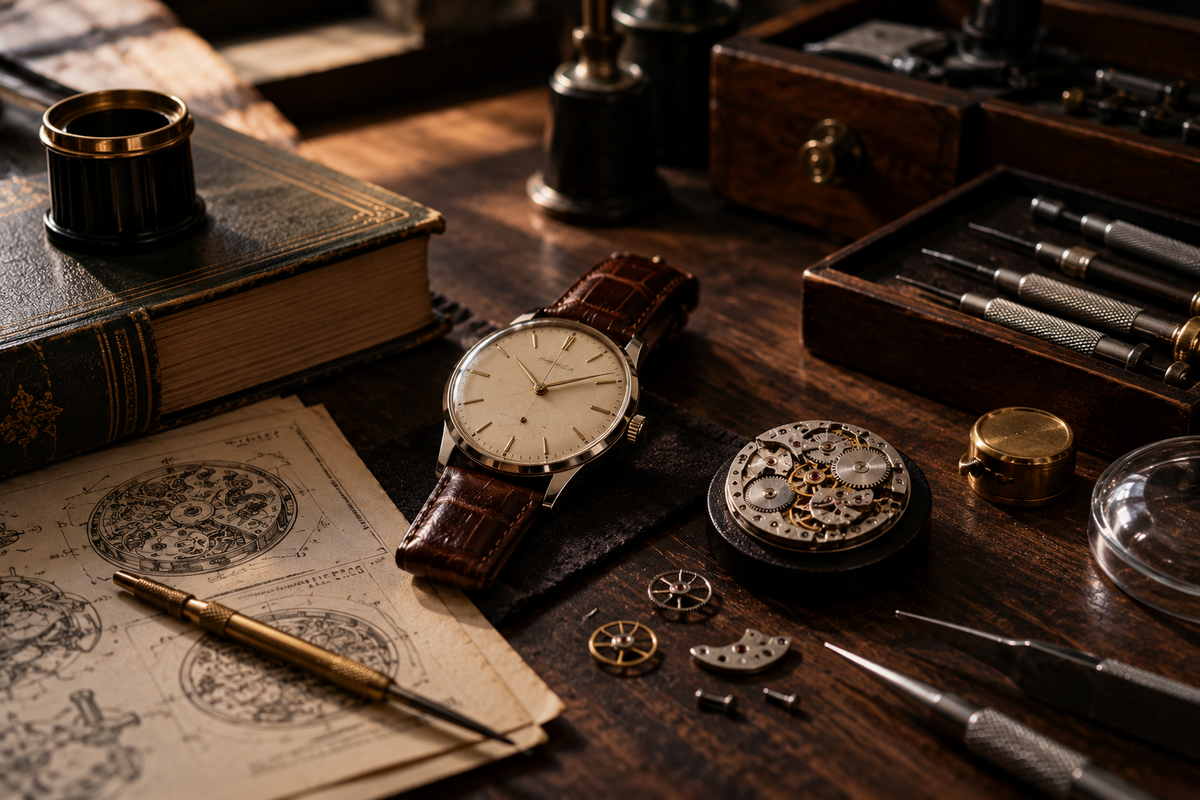
Inside a mechanical movement, a small collection of gears, springs, jewels and levers work together in a carefully regulated sequence. Energy is stored, released and measured through a mechanism that can be understood, adjusted and repaired.
Nothing about it is particularly necessary.
But there is something deeply satisfying about that.
A Machine You Can Understand
Modern technology often asks us to accept complexity without understanding it.
A smartphone is extraordinary, but very few of us could explain how its thousands of components work together. When it stops working, the usual solution is replacement.
A mechanical watch belongs to a different tradition.
Its mechanism can be opened.
It can be inspected.
It can be cleaned, adjusted and repaired.
A watchmaker can look at a movement and understand its history through the condition of its components, the marks left by previous servicing and the way its parts have aged.
That gives the object a different kind of relationship with its owner.
It is not simply something we consume.
It is something we maintain.
The Beauty of Imperfection
Mechanical watches are not perfect timekeepers.
Their accuracy can change with position, temperature, wear and the condition of the movement. A watch that gains or loses several seconds a day may still be functioning exactly as its designers intended.
This imperfection is part of the appeal.
A mechanical watch reminds us that precision does not always mean absolute perfection.
Sometimes precision means achieving an extraordinary result with limited means.
A movement designed decades ago can continue operating because its components were made well, maintained properly and given another chance at life.
That is a different idea of value.
Objects With a Memory
A new watch begins with no history.
A vintage watch begins with questions.
Who wore it?
Where did it travel?
Was it bought for a wedding, a promotion or simply because someone liked the way it looked in a shop window?
The scratches on a case, the fading of a dial and the worn edges of a leather strap can become part of the object's identity.
This does not mean every old watch is valuable.
Age alone is not enough.
What matters is the combination of design, construction, condition, history and the relationship people develop with the object.
A well-made watch can become more interesting as it becomes older because its history becomes visible.
Keeping Rather Than Replacing
The modern economy is exceptionally good at producing replacements.
When something becomes inconvenient, outdated or slightly damaged, buying another one can be easier than repairing the original.
Mechanical watches resist that logic.
A movement can be serviced.
A worn component can sometimes be replaced.
A case can be polished, or deliberately left with its marks.
A dial can age without losing its identity.
The goal is not necessarily to return the object to the condition in which it left the factory.
Sometimes the goal is to preserve what time has added.
That is why restoration can be such a delicate craft.
The restorer is not simply making an old object look new.
They are deciding what should remain.
Why It Still Matters
Perhaps the enduring appeal of the mechanical watch has very little to do with telling time.
It is about attention.
Winding a watch in the morning is a small ritual.
Setting it before leaving the house is another.
Listening to the movement on a quiet evening can be strangely reassuring.
These actions take only a few seconds, but they ask us to interact with an object rather than simply use it.
That distinction matters.
A mechanical watch is a reminder that some things can be valuable precisely because they are unnecessary.
Not everything needs to be faster.
Not everything needs to be connected.
Not everything needs to be replaced.
Some things are worth understanding.
Some things are worth maintaining.
And some things are worth wearing long enough to become part of your own history.