The Quiet Luxury of a Good Fountain Pen
Why a well-made pen can become more than a writing instrument.
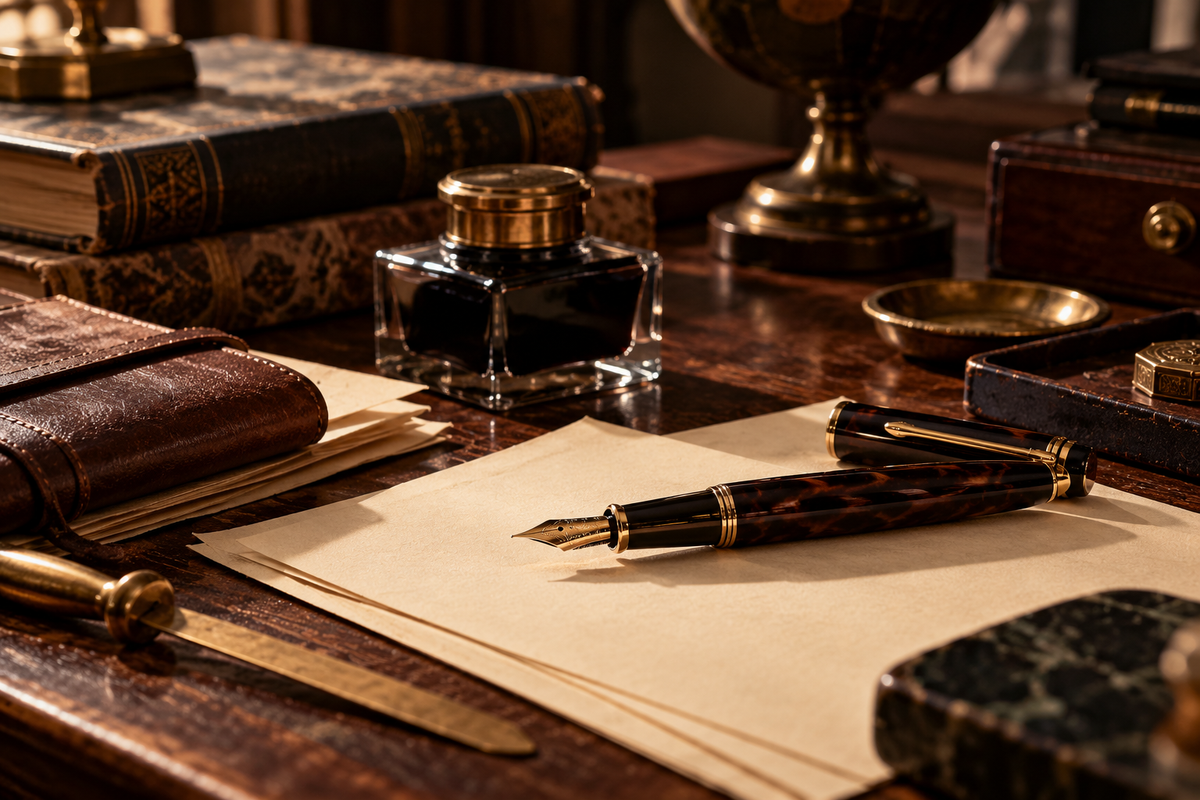
A good fountain pen is an unnecessary object.
There are faster ways to write.
There are cheaper ones, too.
A ballpoint pen can disappear into a pocket without a second thought. A keyboard can produce hundreds of words in the time it takes to write a sentence by hand.
And yet, a well-made fountain pen asks us to slow down.
It turns writing into a physical act.
Ink flows through a carefully shaped nib. The pen moves across paper with a small amount of resistance. The hand adjusts its pressure almost without thinking.
The result is not necessarily better handwriting.
It is simply more deliberate.
An Object Made to Be Used
The best fountain pens are not designed to remain untouched in a display case.
They are meant to acquire scratches.
They are meant to develop small marks where the fingers naturally rest.
They are meant to be filled, emptied, cleaned and eventually passed to someone else.
This is one of the reasons older pens can be so interesting.
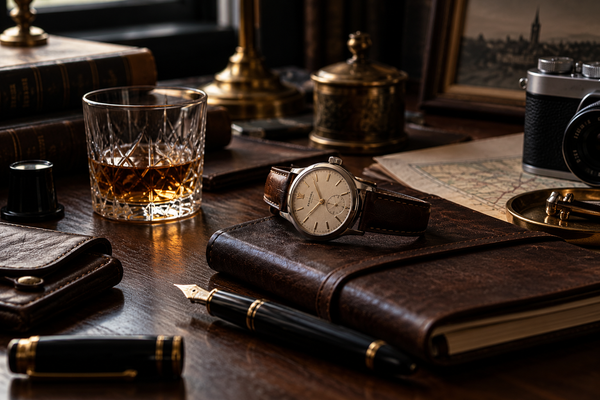
A vintage fountain pen may show decades of use through nothing more than a softened finish and a worn clip. Those marks are not necessarily defects.
They are evidence.
Someone used the pen.
Someone carried it.
Someone wrote with it.
The Pleasure of the Nib
The defining feature of a fountain pen is its nib.
Unlike a disposable ballpoint, a fountain pen allows the writer to feel the movement of the instrument across the page.
Different nibs produce different experiences.
Some are firm and precise.
Others are softer and more expressive.
Some produce a consistent line. Others change their character according to pressure and direction.
This is a small mechanical relationship between hand, instrument and paper.
Once you become accustomed to it, ordinary writing can feel surprisingly different.
Why Materials Matter
A good fountain pen does not need to be made from expensive materials.
Celluloid, ebonite, resin, acrylic, lacquer and metal can all produce beautiful results when they are used thoughtfully.
The important question is not simply what a pen is made from.
It is how the material feels after years of use.
Some surfaces become smoother.
Some develop a deeper colour.
Some acquire tiny marks that make every pen slightly different from another example of the same model.
This is where the idea of patina becomes interesting.
Age does not automatically improve an object.
But when an object was designed to last, age can become part of its character.
The Case for Keeping One
There is a certain freedom in owning one good pen.
You do not need a drawer filled with dozens of them.
You need one that fits your hand, writes reliably and makes you want to use it.
That may be an inexpensive vintage pen.
It may be a modern handmade instrument.
It may be something inherited from a parent or discovered in a second-hand shop.
The price is not the most important part.
The relationship is.
A useful object becomes personal through repetition.
The more often we use it, the more familiar it becomes.
Eventually, we stop thinking about the object itself and simply reach for it.
That is when a tool becomes a possession worth keeping.
Quiet Luxury
Luxury is often described through rarity, price and visible status.
But there is another kind of luxury that is quieter.
It is the ability to choose an object because of how it works.
A fountain pen does not make writing more impressive.
It simply makes the act of writing more tangible.
In a world filled with objects designed to be replaced, there is something satisfying about using one designed to stay.
Perhaps that is the quiet luxury of a good fountain pen.
Not owning something expensive.
Owning something you are happy to keep.